The Hidden Failure Modes of AI Productivity | Transnova
Executive Summary:
AI is delivering impressive performance gains in pilots and controlled environments — but the same technologies are quietly generating burnout, overload, and misalignment in day-to-day work. Field experiments at Harvard and Procter & Gamble show AI can act like a supportive teammate. Real-world workforce data from Upwork, Microsoft, and others shows rising stress, confusion, and trust drift. AI isn’t failing on capability. It’s failing on context, governance, and organizational design.
The Business Reality
Enterprises are pouring capital into AI to unlock productivity, cost transformation, and new revenue streams. On paper, the story is compelling: copilots, automation, and assistants that supercharge knowledge work.
But inside the organization, a different pattern is emerging:
Work feels faster, but not clearer.
Output is up, but burnout is rising.
AI pilots succeed; broad adoption stalls.
A small group of “AI power users” carries the load.
Teams start trusting the tool more than each other.
The net effect: leaders see an AI revolution; employees experience an AI squeeze. The gap between those two realities is where value is currently being destroyed.
Why This Matters
Multiple large-scale studies point in the same direction:
Microsoft’s Work Trend Index shows digital debt and information overload are still climbing — even as AI tools roll out.¹
Upwork Research Institute finds 71% of employees report burnout, and 77% say AI has increased workload or complexity.⁷⁻⁸
Harvard’s “Cybernetic Teammate” study shows AI can boost performance and reduce negative emotions in structured tasks.⁶
At first glance, these findings look contradictory. In practice, they describe two halves of the same story:
AI feels like a teammate in well-designed, time-bound, supported environments.
AI feels like a pressure multiplier in messy, ambiguous, real-world workloads.
That tension is now a board-level issue. AI won’t fail because models are weak. It will fail because operating models, expectations, and workflows weren’t redesigned to carry the new load.
1) The Burnout Cost: Output Up, Capacity Flat
In theory, AI should give people time back. In practice, most teams are experiencing the opposite.
Microsoft’s Work Trend Index shows that despite AI adoption, people still report rising pace, rising information volume, and rising digital debt.¹ Upwork adds harder edges to the picture: 71% of full-time employees report burnout; 65% struggle to meet productivity expectations; and 77% say AI has either increased workload or complexity.⁷⁻⁸
The pattern is simple:
AI increases what’s possible.
Leadership increases what’s expected.
Workload and decision velocity increase — without structural relief.
AI changed the output curve. Human capacity did not.
AI acceleration without workload redesign turns productivity gains into burnout.
Leadership moves
Reduce baseline workload when deploying AI — don’t layer AI on top of full plates.
Explicitly cap “AI-enabled” stretch targets for the first 12–18 months.
Make energy, not just output, a KPI in AI-heavy roles.
2) The Talent Cost: Over-Reliance on AI Power Users
Every organization now has a visible (or invisible) group of “AI naturals” — the power users who experiment, prototype, and ship.
MIT Sloan’s research shows that organizations quickly become over-dependent on this small group, turning them into unofficial architects, trainers, and troubleshooters.² Upwork’s data goes further: high-AI performers experience more burnout and are more likely to consider leaving.⁹
You don’t just have skill concentration. You have risk concentration:
Single points of failure around individuals.
Invisible emotional labor supporting everyone else’s AI learning curve.
Exposure if one or two key people walk.
Leadership moves
Formalize an AI champions network with rotation, not permanent heroes.
Recognize and reward AI enablement work — don’t treat it as “extra effort.”
Document and standardize patterns from power users into playbooks and templates.
3) The Trust Cost: Teams Defer to AI Over Each Other
Stanford’s automation-bias research shows a consistent pattern: under time pressure, people tend to defer to AI outputs — even when those outputs are incorrect.³
Upwork’s data adds a cultural layer: among high-AI performers, 67% report trusting AI more than colleagues, and 64% say they feel they have a better “relationship” with AI tools than with teammates.¹⁰
Left unmanaged, this creates a subtle but dangerous shift:
Peer review drops, because “the model already checked it.”
Challenging the tool becomes socially harder than challenging a person.
Team members stop leaning on each other for judgment and perspective.
When teams over-trust AI, collaboration shifts from human–human to human–tool.
Leadership moves
Define “calibrated trust” as the goal: AI is first draft, not final authority.
Bake peer review and multi-source validation into AI-assisted workflows.
Reward teams for improving outcomes via human + AI collaboration, not AI alone.
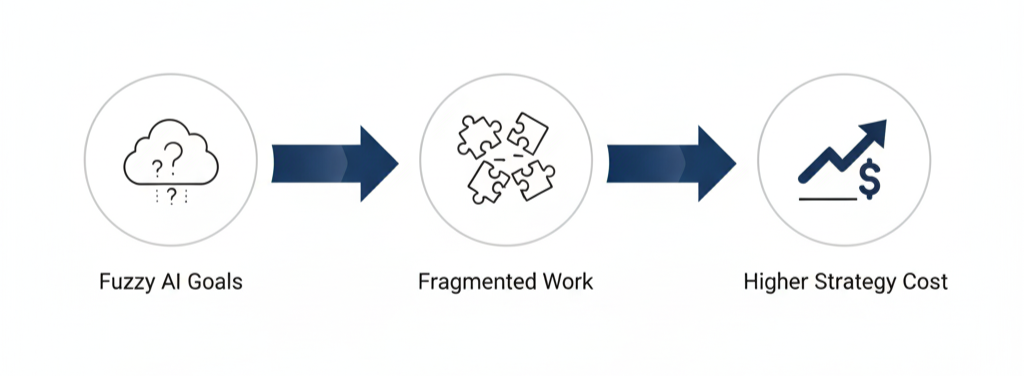
4) The Strategy Cost: AI Goals Are Fuzzy, Work Gets Fragmented
Boston Consulting Group highlights a widening gap: many organizations deploy AI tactically — local pilots, isolated automations — without a clear line of sight to enterprise strategy and value pools.⁴
Upwork’s research makes that gap visible from the workforce side:
96% of leaders expect AI-driven productivity gains.
47% of employees say they don’t know how to achieve those expectations.⁸
That’s not a tooling problem. It’s a strategy translation problem.
When AI workstreams don’t map directly to revenue, cost, risk, velocity, or experience, the result is a cluttered portfolio of activity that looks busy but doesn’t move enterprise KPIs.
Without crisp AI goals and KPI alignment, activity fragments and value leaks.
Leadership moves
Define 2–3 enterprise value pools AI must move (e.g., cost-to-serve, cycle time, NPS).
Tag every AI initiative with one primary KPI and one secondary KPI.
Retire pilots that don’t connect to strategy — even if the tech is impressive.
5) The Manager Cost: Unfunded AI Orchestration Work
Harvard Business Review is clear: middle managers carry a disproportionate share of AI transition friction.⁵ They:
Translate vague AI ambitions into day-to-day workflows.
Coach teams through new tools and changing expectations.
Absorb emotional fallout from fear, confusion, and failed pilots.
Upwork’s numbers (65% struggling with productivity expectations) show where all that weight lands.⁷ Managers become:
AI support desks.
Change managers.
Performance buffers.
None of that is funded, scoped, or realistically resourced in most operating models.
Leadership moves
Give managers explicit AI-related time and capacity, not just new expectations.
Provide decision frameworks, not just tools — “when to use AI, when not to.”
Harvard Business School’s “Cybernetic Teammate” field experiment with P&G found that AI can increase positive emotions and reduce negative emotions during well-structured product development tasks.⁶ Participants felt more excited and less frustrated when using AI to support their work.
But as AI usage scales, other research signals a decline in informal interactions and social capital. When more work is mediated through tools, less happens through human conversation.
Combined with Upwork’s trust and relationship findings, you get a concerning trajectory:
Less spontaneous collaboration.
Fewer weak ties across the organization.
Lower cross-functional empathy and understanding.
It’s not dramatic. It’s gradual. And gradual culture erosion is the hardest and most expensive to reverse.
Leadership moves
Deliberately design “AI-light” collaboration zones and rituals.
Protect team forums where conversation, not tools, is the primary interface.
Treat social connection as infrastructure, not a perk.
Lab AI vs Real-World AI: Reconciling the Research
The Harvard/P&G “Cybernetic Teammate” study and the Upwork/Microsoft data are often read as contradictory. One shows AI improving emotions and performance; the others show AI associated with burnout, confusion, and overload.
They are both right. They are studying different environments.
Diagram 1 — Context Gap: Controlled Tasks vs Live Work
Lab / Controlled AI Environment
Short, time-bounded tasks
Clear goals, clear success criteria
One AI tool, one use case
Training provided upfront
No competing priorities
No backlog or work debt
Psychological safety built in
Outcome:
Higher performance
Higher enthusiasm
Lower frustration
AI feels like a teammate
Real-World AI Environment
Continuous, interrupt-driven work
Ambiguous goals and changing priorities
Many tools, many use cases
Training inconsistent or optional
Conflicting demands and deadlines
Existing workload + AI layered on top
Psychological safety uneven
Outcome:
Higher burnout
Higher complexity
Trust drift (to tools, away from peers)
Manager overload
Fragmented execution
Diagram 2 — AI as Teammate vs AI as Pressure Multiplier
AI as a Teammate (Experimental Context)
AI supports brainstorming and idea generation.
Helps equalize skill gaps across roles and functions.
Provides encouragement and structure during complex tasks.
Connects technical and commercial perspectives.
Improves quality and speed within a bounded activity.
Organizational Conditions:
Scoped challenge with clear problem framing.
Time-boxed sessions and facilitation.
Guardrails on how AI is used.
Learning and experimentation as the primary objective.
AI as a Pressure Multiplier (Live Context)
AI raises expectations for speed and output without capacity relief.
Increases the number of channels, prompts, and tasks to manage.
Becomes a single source of truth that people over-trust.
Blurs ownership of decisions and workflows.
Shifts trust toward tools and away from peers and managers.
Organizational Conditions:
No redesign of roles or workflows around AI.
Vague narratives like “be more productive with AI.”
No explicit capacity trade-offs — just more work.
Limited support for managers orchestrating the change.
Weak feedback loops on stress, adoption, and quality.
AI doesn’t inherently create calm or chaos. The operating model around it does.
The leadership mandate is not “deploy more AI.” It is to engineer the conditions where AI behaves like a teammate, not a pressure source — and to align experiments, pilots, and frontline reality into a single, coherent operating model.
Key Takeaways
AI is outperforming in controlled experiments — but under-delivering in live operations.
Burnout, workload complexity, and trust drift are now core AI-era risks, not side effects.
Over-reliance on a small group of AI power users is a structural talent and continuity risk.
Ambiguous AI expectations create a strategy–execution gap that kills ROI.
Managers are absorbing unfunded AI orchestration work — and burning out quietly.
Culture and connection erode when AI is layered on without redesigning how people work together.
The differentiator will not be “who has the best models” but “who has the best AI-ready operating model.”
AI Productivity: Frequently Asked Questions
Is AI actually increasing burnout, or just changing how work feels?
The evidence points to both. Field experiments show AI can reduce negative emotions during specific, well-structured tasks, but large workforce surveys find that workloads, expectations, and complexity are rising alongside AI adoption. The issue isn’t the model — it’s how organizations redesign (or don’t redesign) the surrounding work.
How can I tell if my AI investments are creating hidden costs?
Look for second-order signals: rising burnout scores, higher attrition among power users, conflicting automation projects, managers acting as ad-hoc AI support desks, and quieter collaboration patterns. When those indicators trend up while AI usage grows, you’re paying hidden productivity tax.
What’s the fastest way to reduce AI-driven overload?
Start by removing work before adding tools: retire low-value reports, cap new channels, and explicitly reduce baseline workload in AI-heavy roles. Then, standardize a small set of approved AI patterns instead of letting every team invent its own workflows.
Where should executives focus first: tools, talent, or operating model?
Tools are the easiest lever to pull, but the operating model is where ROI lives. Focus on clarifying AI’s role in the business model, redesigning roles and workflows around that intent, and giving managers the time and support to orchestrate the change.
Dell’Acqua, F. et al. (2025). The Cybernetic Teammate: A Field Experiment on Generative AI Reshaping Teamwork and Expertise.
Harvard Business School Working Paper 25-043. papers.ssrn.com/sol3/papers.cfm?abstract_id=5188231